


The split keyboard with a trackball, conductor, which went on sale at 8 p.m. on November 24, 2026, sold out its first batch within one minute of sales opening.
Developer Hidetake Horiguchi reported the sellout on his X account and is asking people who want it to be sold again to respond, so he can determine how many to order next time.
The price at DIGIART, the seller, is ¥36,800 (including tax), with initial orders scheduled to ship in sequence from November 25 onward.
Check conductor’s availability at DIGIART

Price increase over the prototype version is modest
conductor is an original keyboard designed by Horiguchi.
It was first sold as a 3D-printed “prototype version,” primarily to YouTube Membership subscribers, and has since been used by many people.
For this release, the 3D-printed case used on previous versions has been replaced with an aluminum case, and the keyboard is being sold as an industrial product.
The editorial team believes that the relatively modest price increase over the prototype version helped prompt many existing users to buy one, leading to the immediate sellout.
A relaunch date has not yet been announced.
In Horiguchi’s post asking for feedback, he suggests two ways to respond: like the post if you’re interested, or reply if you’re strongly inclined to buy one if it goes on sale again.
The responses will help inform the next production run, so anyone hoping for a relaunch may want to react to the post.
A pretty radical keyboard: split, wireless, ortholinear, trackball-equipped, and with a 30% layout
conductor combines 40 keys arranged in a grid at 17 mm intervals with a 19 mm-diameter trackball operated by the right thumb.
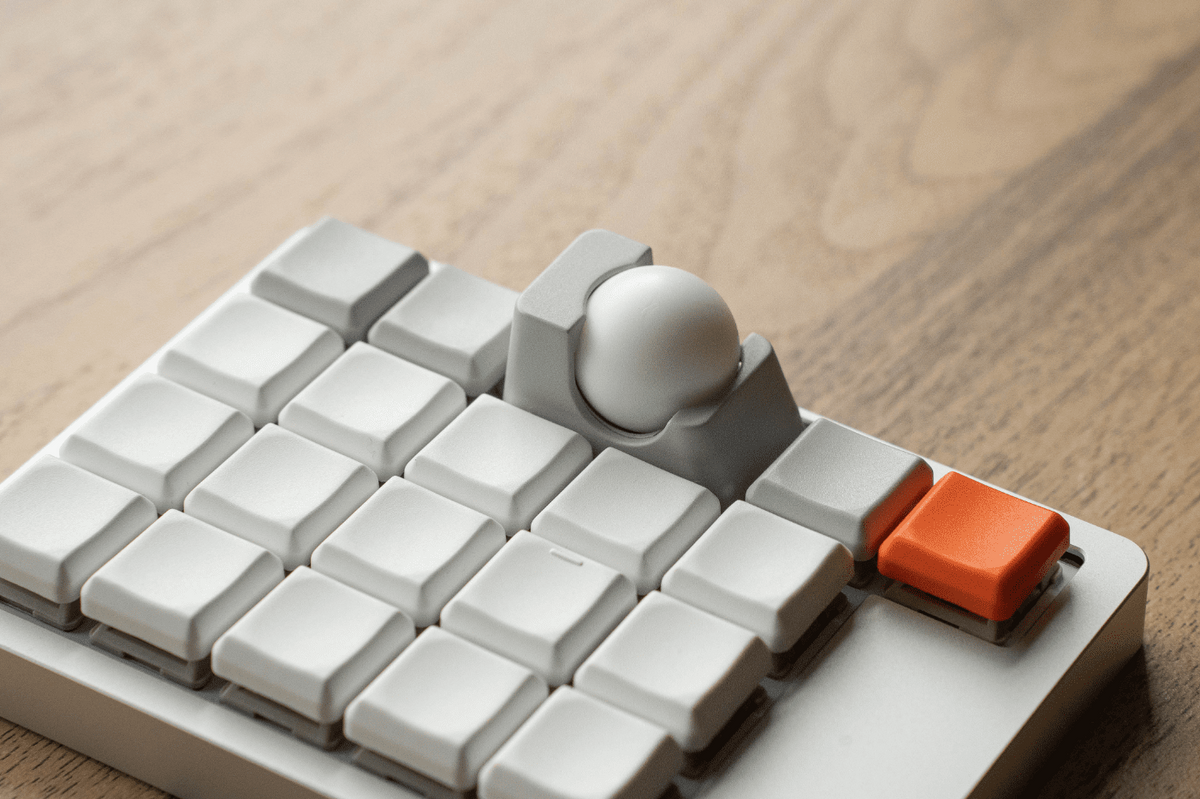
It is classified as a “30%” layout and, compared with the Keychron Orca echo, lacks the outermost column of keys on both the left and right.
In other words, it has no pinky-operated modifier keys such as Shift or Backspace.
These functions therefore need to be assigned in some other way, such as to thumb keys or to long presses of alphabet keys.

As with the Orca echo, the basic approach is to use the thumbs to switch layers for numbers and symbols, and the trackball on the right-hand unit to move the pointer.
One difference is that conductor uses an ortholinear layout.
Greenkeys introduced in its July development update a feature that shows a pressed key responding on the on-screen keymap, so users can check their finger positions after switching layers.

With the production version, “Conductor Studio 2.0,” users can adjust everything from key assignments to trackball behavior in a browser.
| Item | Details |
|---|---|
| Key layout | 40-key ortholinear layout / 17 mm key pitch |
| Case / weight | Machined aluminum / 322 g total for both halves |
| Connectivity | Bluetooth or wired USB to a PC; Bluetooth between the two halves |
| Pointing device | 19 mm trackball for the right thumb |
In the editorial team’s view, conductor’s clear distinction from other small keyboards lies in software that lowers the learning curve.
Being able to type while viewing your own keymap on screen is a major advantage that other keyboards don’t offer.

For the timeline from the preview the day before through launch, see our earlier report on the production-model announcement at 6 p.m. on November 24.
Check conductor’s sales status on DIGIART
- Originally published:
- Last updated:
- Reporting method: Based on official announcements, the sales page, and previous Greenkeys coverage
- Sources
- Conflict of interest: This article contains no monetized links.


Google検索の「優先ソース」にGreenkeysを追加します
Add Greenkeys as a Preferred Source on Google
