


The left-right split keyboard “Jiffy75” attracted significant attention on Kickstarter.

The project ultimately reached its goal on Kickstarter, with over 32 million yen in funding from 835 backers.
This appears to be a product that gained a fairly broad response, not just a niche split keyboard project.
However, viewing this simply as “the split keyboard market suddenly grew” seems a bit off.
My personal view is that Jiffy75 sold well precisely because the market had been established by Cornix.
In this article, we’ll examine the background of why Jiffy75 resonated, based on publicly available information and market observation.

Jiffy75 May Not Have Sold Because It’s a Split Keyboard

I believe there’s a possibility that Jiffy75 didn’t sell simply because it’s a split keyboard.
With its distinctive split layout based on 65%, Bluetooth and 2.4GHz connectivity, and emphasis on comfort and simplicity, it accumulated significant numbers in both backers and funding.
If this could be explained solely by the momentum of the “split keyboard” category, previous left-right split keyboards should have sold much more widely.
However, there haven’t been many instances where a split keyboard has gained this much attention from a mainstream audience in Japan; at least within my own observation, the Cornix made quite an impression.
In fact, in Japan where most users are said to use Japanese layout keyboards, English layout left-right split keyboards are quite niche.
Cornix Likely Moved the Market First

In my assessment, Cornix was what moved the market first.
Cornix was sold in GB format at Yushakobo, and subsequently pre-orders continued through the third round at Jezail Funder Japan.
Moreover, the third round closed earlier than initially planned due to approaching the upper limit of component preparation.
From publicly available information alone, we can interpret that it was judged worthwhile to sell continuously in Japan, not just once.
While total sales numbers haven’t been disclosed, looking at the sales timeline, there’s room to consider that Cornix was a product that gained strong traction in Japan and expanded market awareness.
 Kawamura
From my impression of watching purchase reports on social media, it seemed to resonate more with gadget enthusiasts than with custom keyboard users or keyboard fans.
In other words, I interpret it as having reached broadly beyond the keyboard core audience.
The Switching Cost to Cornix Is High and Can’t Be Overcome by Passion Alone
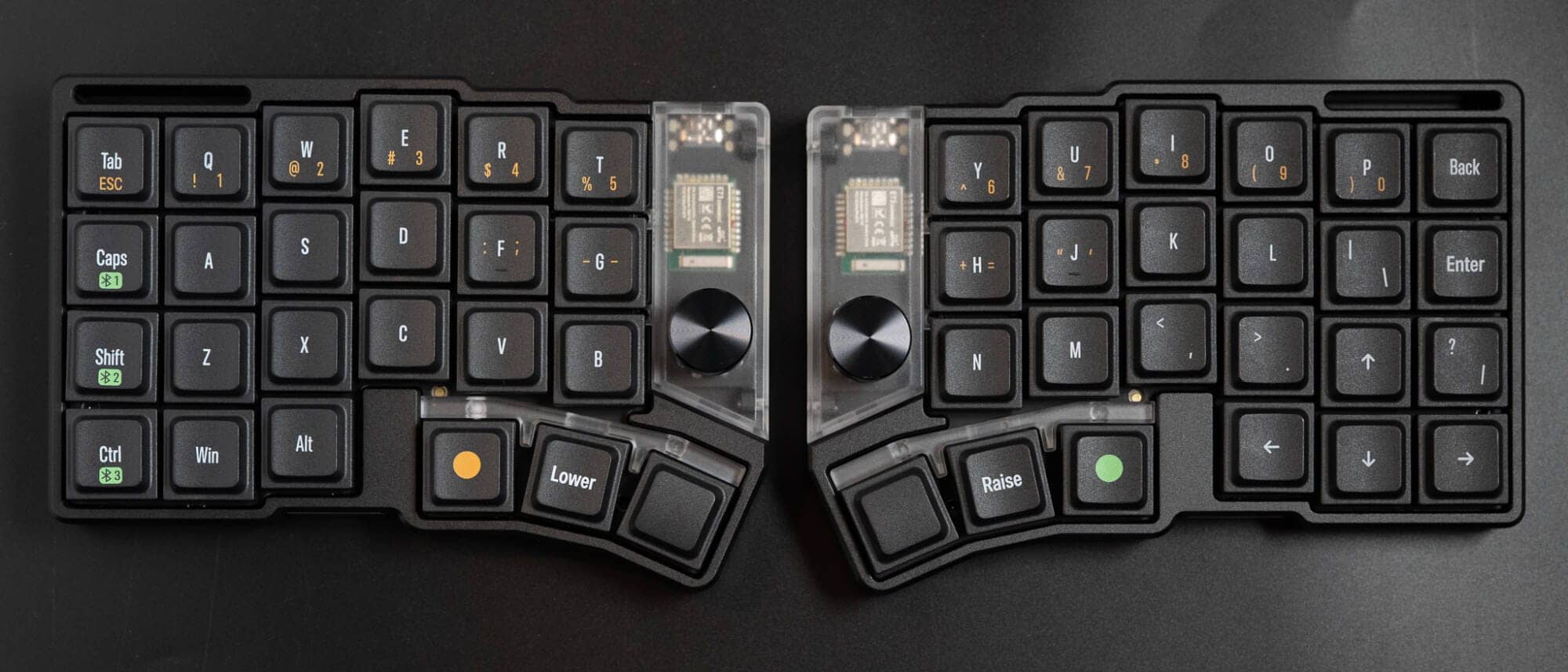
It’s obvious to anyone that Cornix is a product with high adoption costs.
With significantly fewer keys than usual, an English layout-based design, left-right split, columnar staggered layout, and a typing experience based on layer key input, there are barriers difficult to overcome with just “this looks interesting!” enthusiasm.
In other words, it’s a gadget that requires a certain level of “proficiency” to use effectively for business purposes.
In that sense, while Cornix “widely made people aware of the existence of split keyboards,” there’s a possibility it didn’t fully fill the gap for “the next keyboard” for people who want to use one daily for actual work.
However, awareness of the “split keyboard” genre and “that interesting-looking brand releasing them = Jezail Funder” did advance.
But the receptacle for full adoption was still insufficient.
Viewing it as Jiffy75 entering at that point makes the crowdfunding results make sense.
Jiffy75 Fit the “Next Keyboard” Slot with Lower Switching Costs

I believe the reason Jiffy75 resonated wasn’t just the split keyboard category itself, but that it possessed multiple elements easily accepted in the current market.
In other words, there’s a possibility it resonated with users who were interested in Cornix but gave up due to switching costs, thinking “if only it had normal row-staggered layout and a normal number of keys.”
I feel the following three points were particularly effective:
- Fully wireless
- Low-profile design that doesn’t require a palm rest
- Refined appearance that looks cool
- Equipped with the newly developed “MIST” silent linear key switches, making it perfect for office use.
For people who learned about “the split option” through Cornix, Jiffy75 may have appeared easier to incorporate into daily use.
In other words, Jiffy75 seems to have been a product that fit cleanly into an already emerging interest, rather than creating a market from zero.

Background on Why Being a Split Keyboard Doesn’t Mean “It Will Sell”
Just because Jiffy75 sold well doesn’t mean “split keyboards will sell in Japan.”
Jiffy75 had the right “conditions for selling.”
- Ease of wireless adoption
- Good compatibility with the recent low-profile trend
- Refined design
- A compact key layout that captures the best of 65% while staying close to a 75% form factor
- Ability to ride the market context after Cornix
If these conditions change, even the same “left-right split keyboard” will be received very differently.
summary

I view Jiffy75’s response as more naturally understood as a phenomenon occurring within the market context that gradually developed after Cornix, rather than as a one-time coincidence.
There’s no guarantee that the next split keyboard will be received in the same way.
Cornix had repeated sales in Japan, and Jiffy75 was positioned as a successor, marketed as a split keyboard easier to adopt for daily use.
However, this doesn’t mean “any split keyboard will sell.”
Rather, what’s being questioned is how clearly you can design whose work or lifestyle the product will resonate with.
Having covered various keyboards through Greenkeys, I’ve come to feel anew that what’s important is product design that emphasizes the “experience aspect”—what changes users can enjoy through the product—rather than spec-focused marketing, and building promotional channels that enable the product to sell.
Wow, the keyboard market is quite deep.


- First draft written: April 10, 2026
- 最終更新日:2026年4月11日
- Method of coverage: Crowdfunding page
- Reference and citation: https://www.kickstarter.com/projects/jezailfunder/jezailfunderjiffy75-a-unity-75-split-keyboard?lang=ja
- Conflicts of Interest: Product Offering: None Monetization Link in this paper: None


Google検索の「優先ソース」にGreenkeysを追加します
Add Greenkeys as a Preferred Source on Google

