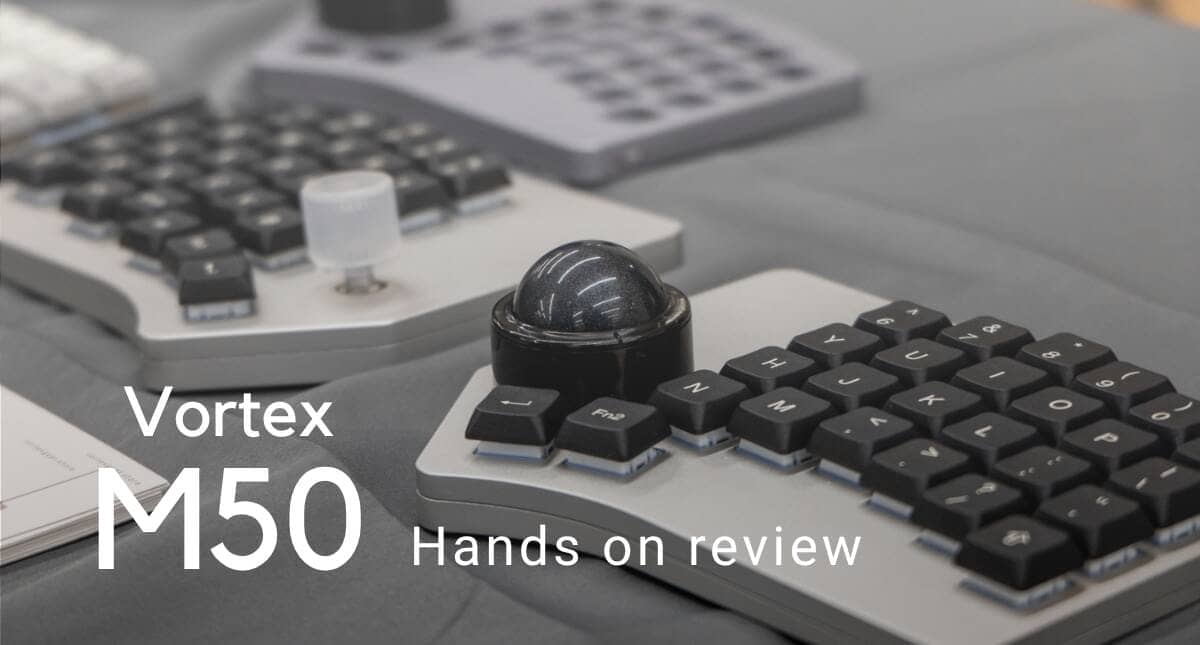



On March 24, 2026, Vortex announced the M50, a split keyboard with trackballs.

Given the announcement timing, there were expectations for an exhibit at Keyboard Market Tokyo 2026, and as anticipated, it was on display.

The M50 is explicitly “developed with a focus on Japan’s DIY keyboard scene and prioritizes sales in Japan.”
In this article, we’ll share details about the M50 gathered from the Vortex booth at Keyket.


Vortex M50 Overview
First, let’s review the M50’s specifications.
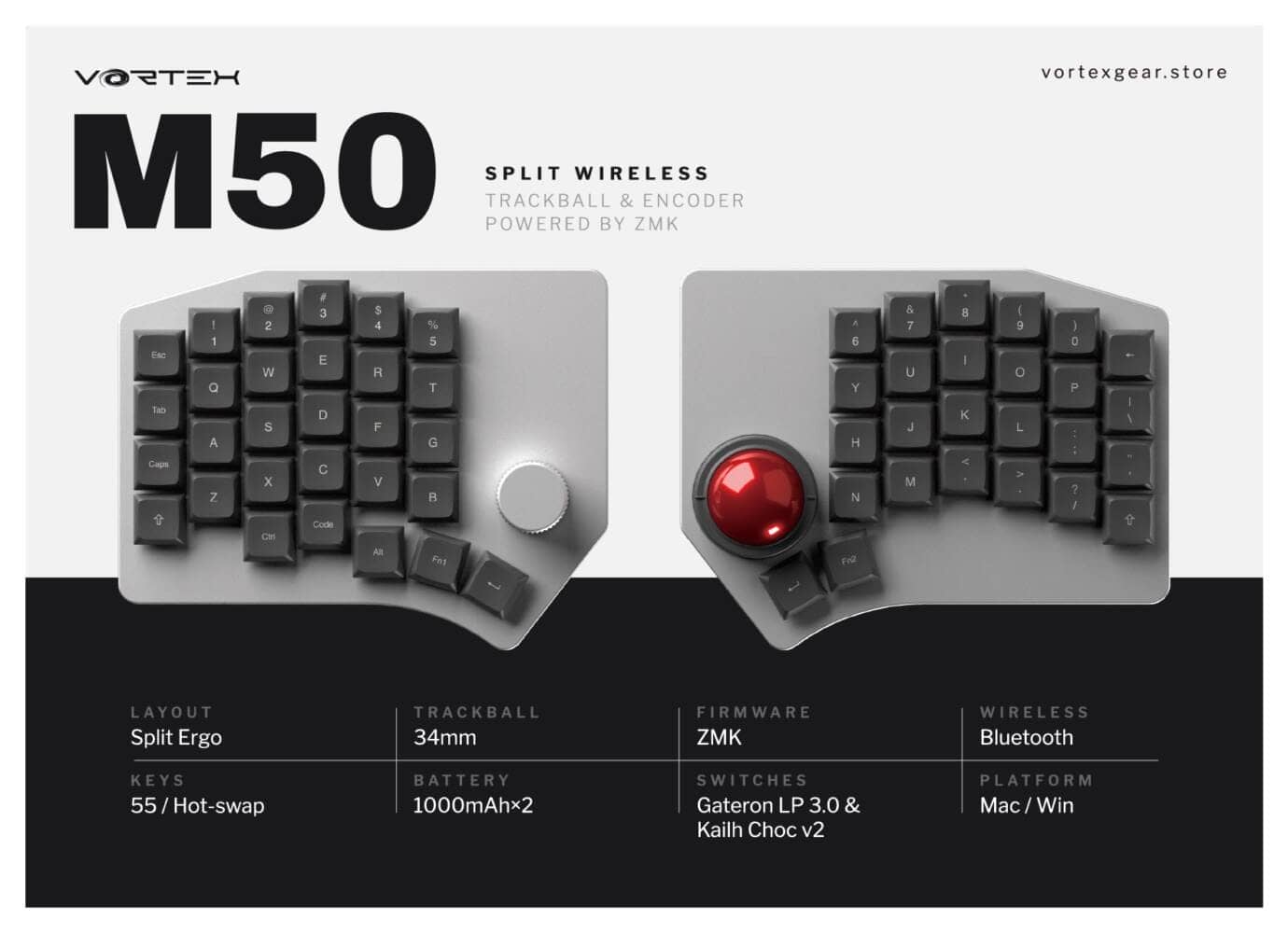
| (data) item | What can be confirmed at this time |
|---|---|
| Product name | Vortex M50 |
| type | Split Wireless Keyboard |
| Color* | Silver, Beige |
| Case* | CNC-machined aluminum |
| Mount* | Integrated switch plate top mount |
| Switch Plate* | Aluminum (1.3 mm thick) |
| layout | Split Ergo |
| Keycaps* | VTG profile (low-profile) |
| Number of keys | 55 key |
| hot swap | support |
| trackball | 34mm |
| encoder | equipped (with) |
| firmware | ZMK |
| connection | Bluetooth |
| left-to-right connection | Fully wireless |
| battery | 1000mAh x 2 |
| Supported OS | Mac / Win |
| Supported Switches | Gateron LP 3.0 / Kailh Choc v2 |
| Switch description on the product page | Low Profile Silent Red / Low Profile Brown |
| Sales | Sold out / In progress |
| Price | 0.00 USD Display |
The above information is based on what was heard. The actual product may differ.
Vortex M50 Hands-On Report

Now let’s take a closer look at the M50 unit.
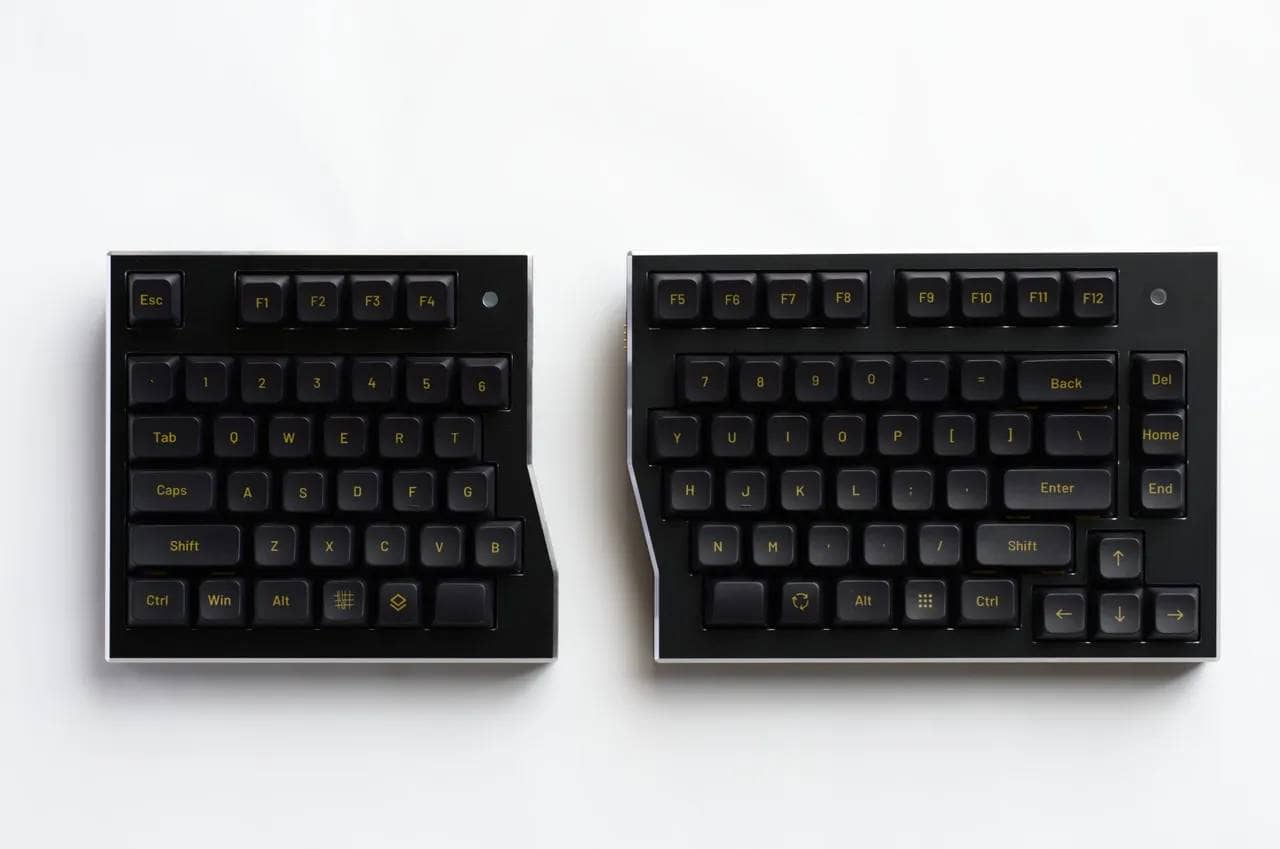
The M50 is a low-profile mechanical keyboard with a split column-staggered layout.
It features a two-piece construction with the top case and top plate integrated.
There is a USB Type-C port on the outer side of the case, but given that both left-right communication and PC communication are fully wireless, this may be for charging the internal battery.*

The typing feel is quite firm with no flex, as expected from an aluminum top mount.
While they are considering adding cushion foam in the production version, the display unit had no foam, resulting in noticeable metallic resonance inside the case.
The switches are compatible with Kailh Choc v2 and Gateron LP 3.0, suggesting it will likely use a multi-socket PCB.*
The Greenkeys editorial team has not previously encountered a structure that allows simultaneous use of these two key switches.
 Greenkeys Office
To accommodate both key switches with a single switch plate, the plate thickness was set to 1.3 mm.
This structure is very informative.

The left side features a rotary encoder knob.

The rotary encoder knob is currently made of resin, but may be changed to aluminum in the production version.*
Let’s look at the right side.
The right side has a 34 mm diameter trackball mounted in the center front section.
Since the trackball is not embedded in the case, you can see from this angle that it sits quite high.
The trackball uses zirconia support balls in a three-point configuration, and the trackball itself is replaced from above by removing the lid on top of the trackball case.
Greenkeys OfficeWhile there’s a trade-off with operability, a 25 mm trackball would likely be preferred based on height alone.
What caught the editorial team’s attention most was the space on the front side of the right half only.
Surprisingly, this space was left open while considering a mechanism that would allow the trackball to be relocated.
In other words, there’s a possibility that users will be able to choose the trackball position according to their preference.*

When asked about key layouts, it appears they are also considering a 40% layout without the number row, in addition to the current 50% layout.*
The editorial team believes that the lower limit for commonly used key layouts is around 60%, and anything below that physically reduces the number of keys, requiring layer operations and increasing switching costs.
Additionally, the column-staggered layout, which has limited everyday use, is another factor that increases switching costs.
Considering these factors, around 50% may be preferable for beginners.
On the other hand, in the context of custom keyboards, given that moNa2 (30% layout) and Keyball44 (40%) are popular, an even more “niche segment” may consider 50% too large.
In that sense, offering a 40% layout “M40” may have significant meaning from a sales strategy perspective.*

As for color options, there are currently two types:


Summary | Watch for Vortex’s Growing Presence in the Japanese Market

Above, we’ve shared key points about the Vortex M50 based on hands-on experience.
The editorial team sees two significant aspects to this product.
First, styles that have emerged from Japan’s custom keyboard scene are taking shape as a manufacturer-produced “finished product.”
Elements such as split design with trackballs and column-staggered layout have developed within the custom keyboard context originating from the “Keyball” designed by Yowkees.
Tracing the Keyball lineage further reveals Corne designed by foostan, Helix designed by Kurauchi who has been influential in design philosophy, and the recently popular Corne-inspired finished keyboard “Cornix“—all demonstrating that the Japanese-origin split and compact keyboard movement continues to expand.
Vortex, an overseas manufacturer, is embracing this movement as a “finished product” and positioning it as a product for the Japanese market.
This is where the M50’s appeal lies.
Second, Vortex appears to be refocusing strongly on the Japanese market.
Vortex is not entirely new to the Japanese market. In the past, Archisite served as the domestic distributor, but Vortexgear is now listed as a “discontinued brand” on the official Archisite website.
Meanwhile, the official Vortex store has a Japan region and lists the M50 as a product “in progress.”
In other words, while the connection with the Japanese market has narrowed, the brand itself may now be attempting to reconnect directly with Japanese users rather than through distributors.
Furthermore, Vortex joined the Japan Layout Alliance on December 26, 2025.
While no specific Japanese layout models have been announced yet, this is noteworthy as a move focused on the Japanese market.
The Japanese keyboard market is not simple enough for overseas manufacturers to succeed by simply bringing in their products.
There is unique accumulated knowledge encompassing layouts, sizes, usage patterns, and even cultural context.
That’s why it’s interesting to see how Vortex is approaching the Japanese market.
The M50 appears to be a very intriguing product as an entry point.
Going forward, will this be a one-off attempt, or will it lead to continued product development grounded in Japanese keyboard culture?
Greenkeys will continue to follow Vortex’s next moves.
- First published: April 4, 2026
- Last updated: April 4, 2026
- Coverage method: On-site coverage at Keyket 2026
- References: https://vortexgear.store/en-jp/products/m50
- Conflicts of Interest: Product Offering: None Monetization Link in this paper: None
Greenkeys operates solely on performance-based advertising and does not use Google ads because they reduce usability.
Please support us through Buy Me a Coffee if you enjoyed reading the article so that we can continue to operate the media.