


The other day, I made this post on Daily Greenkeys.

The massive success of the Keychron Orca echo is evident in numbers anyone can see.

At the same time, watching the reactions surrounding it on social media has increasingly made me reconsider the relationship between commercial products and DIY keyboard culture.
This is not the first time ideas from the so-called “DIY” context have been turned into products.
Still, the reason the Orca echo keeps being brought up is undoubtedly because anyone can see “it’s selling.”
With this hit, more people will learn about split keyboards and keyboards with trackballs.
If that leads to broader interest in individually designed keyboards and the typing experience itself, ultimately expanding the entire Japanese keyboard market, nothing would make me happier.
I strongly hope for such an “expansion of the Japanese keyboard market scene.”
If this kind of flow emerges, commercial products need not compete with DIY keyboard culture and could even serve as an “entry point” for the overall typing experience.
On the other hand, when ideas nurtured within DIY keyboard culture lead to mass-produced products, there’s a difficult question: to whom and in what form should profits and recognition be returned?
I’d like to think about that a bit today.

Ideas Grown in DIY Keyboards Become Mass-Produced Products
The Orca echo is a product that Keychron created based on a concept proposed by Mr. Nakahashi of Gizmodo Japan.
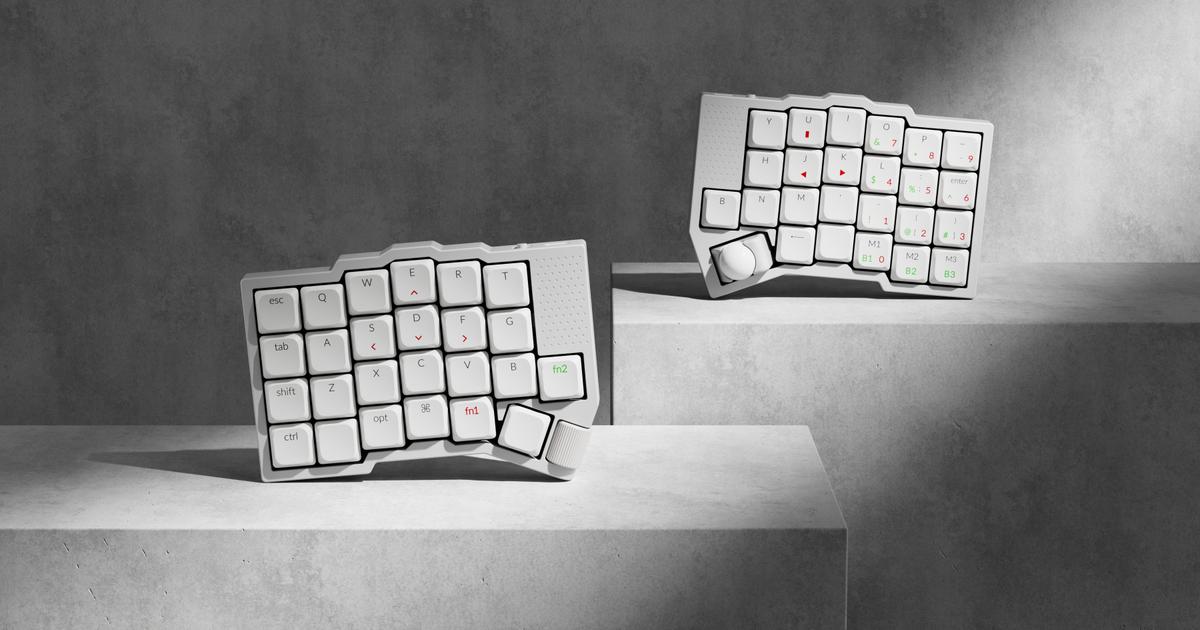
The Orca echo’s major features—split design, column stagger, thumb-operated trackball, and the layer concept that compensates for fewer keys—are elements that have long been tested and developed within DIY keyboard culture.
What makes this difficult is that you cannot treat a specific product or design the same way as ideas shared within a culture.
With design data or source code, you can verify usage conditions through licenses.
However, concepts like “making it split” or “placing a thumb-operated trackball” don’t have a single person’s name or license attached to them.
They’ve been gradually shaped through trial and error by many designers and users.
In other words, these ideas have become “part of what’s been cultivated within the culture.”
In Japan’s DIY keyboard scene, the representative presence that widely popularized the “split keyboard + thumb trackball” configuration is likely Yoichiro’s Keyball series.
The GitHub repository where Keyball’s design data is published displays GPL-3.0.
GPL-3.0 is not a license that prohibits commercial use or sales themselves.
However, when distributing works covered by GPL-3.0, or modifications of them, to third parties, there are conditions such as maintaining license notices and making corresponding source available.
That said, exactly how and to what extent GPL-3.0 applies to the firmware, PCB data, case data, and other elements in the repository needs to be verified individually.
On the other hand, the idea itself of “combining a split keyboard with a thumb trackball” is separate from the specific code and design data on GitHub.
What I want to consider here is not repurposing Keyball’s data for commercialization, but rather how concepts cultivated within DIY keyboard culture lead to commercial products through original designs.
Who Should Own Ideas Grown Within a Culture?
When ideas nurtured in DIY keyboard culture become commercial products, it’s natural for people to think “individual developers should also receive some recognition or profit.”
If a specific design, mechanism, or published data is used directly, then after confirming the usage conditions, approaches like contacting the designer, providing credit, supervision, or joint development could be considered.
However, the situation differs when an original product is designed based on concepts developed within the broader culture.
Even if many people influenced that idea, you cannot designate any single person as the rights holder.
Also, from what I briefly researched, patent documents combining keyboards and trackballs already existed at least in the 1990s.
This is one prior example showing that the broad concept of “combining a keyboard with a trackball” did not originate with Keyball.
The first person to split a keyboard, those who proposed ergonomic layouts other than row stagger, those who advocated utilizing the thumbs, those who suggested operating trackballs with the thumb, those who realized the layer concept for small keyboards—
Each of these contributions has accumulated and connected to the present in the form of “culture.”
That’s why, when commercializing ideas grown within the entire culture, I think it’s difficult to organize that relationship solely by distributing profits to one specific person.
Commercial products bring in new users, and beyond that, interest spreads to individually designed keyboards and DIY parts.
The emergence of such circulation of market and interest could be an important perspective when considering the relationship between manufacturers and DIY keyboard culture.
Does Commercialization Destroy DIY Keyboard Culture?
Mass-produced products have strengths that DIY keyboards don’t.
First, because they’re complete, anyone can use them easily.
This is something only mass-produced products can do.
Also, being industrial products, they have less variation in quality and come with warranties—aspects that differ significantly from individually distributed works.
With these conditions in place, the “typing experience itself” born in DIY keyboards reaches more people.
I think the background to this hit was driven more by the desire for “a new typing experience” than by the need to “build a keyboard.”
On the other hand, there’s also the possibility that only mass-produced products get attention, while the individual developers, DIY keyboard culture, and associated parts sellers behind them become invisible.
Whether commercialization destroys culture depends not on the product selling itself, but on what kind of flow emerges afterward.
Mass-produced products spark interest, leading more people to seek out individually designed keyboards.
Individual developers’ products meet the detailed needs that commercial products don’t satisfy.
New ideas tested by individual developers lead to the next generation of products.
If such circulation emerges, commercial products and DIY keyboards aren’t just opposing forces.
Following this example, it’s entirely possible that commercial products incorporating ideas from the “DIY keyboard genre” will be released.
The great thing about keyboards is that “you might not be satisfied with just one.”
Surely, those who purchase the Orca echo may find themselves wanting another keyboard.
DIY keyboards could well be among the targets of that “next interest.”
However, when purchasing DIY keyboards, I also think it’s important not to misunderstand that “it’s not a manufacturer product, so there’s a degree of self-responsibility.”
The Next Demand Born from the Orca Echo
Likely, the Orca echo’s success will create two trends among users after purchase.
One is the flow of “I just couldn’t get used to it after all.”
Getting accustomed to the layer concept takes time, and combined with the unfamiliar column stagger layout, trackball operation, and split design—a keyboard loaded with all these new elements—there will naturally be cases where people give up without mastering it.
However, this doesn’t only work negatively.
The physical impact of a split design, the finger movement characteristics of column stagger layout, the comfort of a trackball, empathy with the layer concept—at the very least, the experience of turning “what you imagined in your head” into an actual “typing experience” you can call your own has tremendous value.
This value allows you to further refine your “thinking about typing.”
You might realize that you’re actually better suited to the familiar row stagger layout than column stagger, or that while the layer concept was difficult, the trackball was quite convenient, so you’d like a 65% keyboard with a thumb trackball—forming “an image of your new typing experience.”
The other flow is mastering it, thinking “This really suits me.”
Likely, if you master the Orca echo, you’ll develop further “desires” like “Can I optimize the key count?” “Can I reconsider the trackball position a bit more?” “An aluminum case might make typing more stable.”
Which flow becomes more common won’t be clear until the product actually arrives.
However, even if it didn’t suit you, actually trying split design, column stagger, and layer operation will help some people see what typing environment fits them.
Meanwhile, among those who master it, some will broaden their interest to other keyboards, seeking layouts and trackball positions that suit them even better.
Whether the Orca echo becomes an entry point for discovering new typing experiences—that evaluation will emerge after the product reaches users’ hands.
What Kind of Circulation Will Emerge Beyond Commercialization?
The Orca echo has not yet reached users’ hands at this point.
What kind of evaluation actually emerges will become clear after the product arrives and many people start using it.
Also, I’d like to pay attention to what flow of interest toward DIY keyboards and individual developers emerges from this hit.
For example, Jezail Funder, which offers the Cornix inspired by the Corne, sells injection-molded stem parts for DIY keycaps called “J-STEM-LP01.”

This is one interesting example of expanding a manufacturer’s production capabilities into a form usable on the DIY keyboard side.
There’s no set correct answer for the relationship between manufacturers and the DIY keyboard community.
Sometimes it’s providing new parts or development environments; other times it’s bringing in new users through mass-produced products and expanding interest toward individually designed keyboards and peripheral parts beyond that.
I’d like to watch the next flow born from the Orca echo, including how Keychron will build its relationship with DIY keyboard culture going forward.
Greenkeysの活動を支援する
Greenkeysでは、記事の閲覧を妨げるGoogle AdSenseなどの第三者配信型ディスプレイ広告を使用していません。
製品の構造や設計思想を掘り下げる記事、イベント取材、キーボード文化に関する記録など、販売に直接つながりにくいテーマも継続して公開しています。
この記事が役に立った、または今後もこうした記事を読みたいと思っていただけた方は、Buy Me a CoffeeからGreenkeysの活動をご支援いただけます。

支援金の使い道やGreenkeysの運営方針については、「Greenkeysの活動を支援する」をご覧ください。
- First published: July 24, 2026
- Last updated: July 24, 2026
- Reporting method: None
- References: See text
- Conflicts of Interest: Product Offering: None Monetization Link in this paper: None
*The author operates a business providing product planning and market feedback to keyboard manufacturers both domestically and internationally.


Google検索の「優先ソース」にGreenkeysを追加します
Add Greenkeys as a Preferred Source on Google

