


Recently, “ceramic” has been emerging as a new material choice for keycaps.
Ceramic keycaps offer a hard touch, a cool texture, and a unique typing sound that differ from common resin keycaps like ABS or PBT, proving that the material itself significantly impacts the typing experience.
The TacType Ceramic Keycaps we’re looking at today are characterized by their use of zirconia ceramic.
Cerakey, the pioneer of ceramic keycaps, uses alumina ceramic. It’s no exaggeration to say their legendary keycaps have become the milestone for the entire category.
The highlight of TacType Ceramic Keycaps isn’t just that they are ceramic, but that they utilize zirconia ceramic, setting them apart from Cerakey.
If Cerakey is the brand that expanded the ceramic keycap genre, TacType can be seen as the brand carving out a niche with the material difference of “zirconia ceramic.”
In this article, I’ll review the TacType keycaps, which present a new option for ceramic keycap enthusiasts.
What is TacType?
- An emerging brand specializing in zirconia ceramic keycaps
- Material: 95% Zirconia Ceramic
- Cherry Profile
- Designed for ANSI layout
- Compatible with MX-style switches
- Available in 4 types: White Glossy / White Matte / Black Glossy / Black Matte
- Choose between Side Print and Blank
- Kit options: Full / TKL / 60% / Alphas / Modifier / RX1U, etc.
- Release Date:
- White: May 19, 2026
- Black: During June 2026
- Affordable pricing, such as $74 for the Full Kit and $59 for the TKL Kit
- Special launch pricing for the first 3 days
This article includes a reader-exclusive coupon through our partnership with TacType. Use it for a $5 discount on orders over $59; it can even be combined with sale prices.
TacType Ceramic Keycaps were provided for promotional purposes. If you make a purchase through Greenkeys, the operator GreenEchoes Studio may receive a referral fee. Product evaluations are based on Greenkeys’ editorial policy and reflect actual usage.

- セラミックキーキャップとして価格が抑えられている
- ジルコニアセラミックという素材差がある
- 表面の均一性が高く、特にGlossyタイプの質感が美しい
- PCステムによる柔らかいバックライト透過を楽しめる
- スペースバー用の補助スプリングが同梱されている
- Full Kitだけでなく、分割キットで部分導入しやすい
- スペースバーの重量には注意が必要
- Matteタイプはスクラッチに注意したい
- 基本的にはANSI配列向けで、日本語配列にはそのまま使いにくい
- 黒系キーキャップは白系と比べてバックライト透過が控えめ
- Cerakeyとは白の色味が異なる
- 打鍵音の違いは劇的ではない

About TacType Ceramic Keycaps

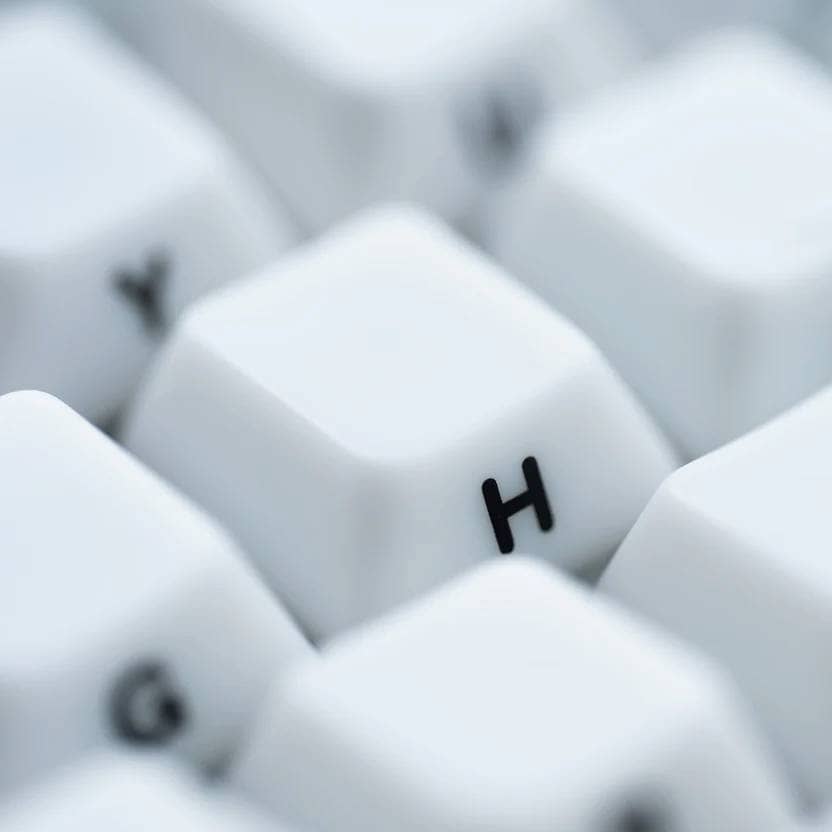
TacType Ceramic Keycaps are a keycap set made from zirconia ceramic.
Unlike the ABS and PBT plastics used in typical keycaps, these are characterized by the hard feel, smooth texture, and weight unique to ceramic materials.
The lineup includes a Full Kit for full-sized keyboards, a TKL Kit, a Split Kit-60 for 60% boards, a Split Kit where you can choose alphas and modifiers separately, and an RX1U Kit containing four 1U keys.

You can choose between White and Black colors, Glossy or Matte finishes, and Blank or Side Print legends.



| Item | Details |
|---|---|
| Brand | TacType |
| Product Name | Ceramic Keycaps |
| Material | 95% Zirconia Ceramic |
| Stem | PC Plastic |
| Profile | Cherry Profile |
| Compatible Switches | Cherry MX-compatible switches |
| Layout | ANSI |
| Color | White / Black |
| Finish | Glossy / Matte |
| Legends | Blank / Side Print |
| Kit | Full / TKL / 60% / Alphas / Modifier / RX1U |
| Price | Full $74, TKL $59, 60% $39, Alphas $33, Modifier $26, RX1U $6.99 |
| Warranty | 1-year limited warranty against manufacturing defects |
Release Date
- White: From May 19, 2026, at 11:00 PM (JST)
- Black: During June 2026
Sale Period: May 19, 11:00 PM – May 22, 11:00 PM
Kit Configurations and Pricing
| Kit | Price | Key Count | Intended Use |
|---|---|---|---|
| Full Kit | $74 | 123 keys | For full-sized keyboards |
| TKL Kit | $59 | 101 keys | TKL / 75% / 65% / 60%, etc. |
| Split Kit-60 | $39 | 71 keys | For 60% class boards |
| Split Kit-Alphas | $33 | 56 keys | Mainly alpha keys |
| Split Kit-Modifier | $26 | 45 keys | Mainly modifier keys |
| RX1U 4 pcs | $6.99 | 4 keys | For accents or additions |

TacType offers not just full sets, but also split kits like Alphas and Modifiers.
It’s great that you don’t have to replace every single key; you can choose to ceramicize just the alphas, just the modifiers, or even just a few 1U keys.
Since the profile is a standard Cherry-like shape, it’s easy to imagine mixing and matching them with your existing keycaps.
About Weight
| Key Size | Weight |
|---|---|
| 1U | 4–4.5 g |
| 1.25U–1.75U | 5–6.5 g |
| 2U–2.75U | 7.5–9.5 g |
| 6.25U Spacebar | 25 g |
Ceramic keycaps are significantly heavier than standard resin ones.
With a 1U key weighing 4–4.5 g and a 6.25U spacebar at 25 g, the configuration is clearly heavier than typical ABS/PBT keycaps.
It’s important to note that keycap weight affects not just the sound, but also the switch return and stabilizer behavior.
Particularly with light switches, the return might become sluggish.
 Greenkeys Office
In our tests, we used switches with a 42 gf actuation force, and the return wasn’t significantly impacted for most keys.
However, the spacebar’s return was affected, so we swapped it for a switch with a higher actuation force.
Alternatively, you could use the included auxiliary springs.
Comparison with Cerakey
Naturally, the main point of interest is how they differ from the pioneer, Cerakey.
Here is a summary of the spec differences.
| Item | TacType | Cerakey |
|---|---|---|
| Primary Material | Zirconia Ceramic | Alumina Ceramic |
| Main Component | ZrO2 | Al2O3 |
| Brand Positioning | Emerging ceramic keycap brand | Leading ceramic keycap brand |
| Characteristics | Emphasizes toughness, density, and a heavy feel | Hardness, wear resistance, and established reputation |
| Profile | Cherry Profile | Cherry Profile |
| Stem | PC Plastic | ABS Plastic |
Alumina ceramic is known as an industrial ceramic with excellent hardness and wear resistance.
On the other hand, zirconia ceramic is known for its toughness—meaning its resistance to cracking or chipping.
Differences between Zirconia and Alumina Ceramic
| Comparison Item | Zirconia Ceramic | Alumina Ceramic |
|---|---|---|
| Main Component | Zirconium Oxide / ZrO2 | Aluminum Oxide / Al2O3 |
| Key features | Toughness, high fracture toughness, premium texture | Hardness, wear resistance, stability, industrial track record |
| Resistance to Cracks/Chips | Relatively strong | Hard, but prone to chipping/cracking from impact |
| Hardness | Generally slightly lower than alumina | Extremely high |
| Weight Feel | Higher density than alumina; tends to be heavier | Tends to be lighter than zirconia |
| Texture Direction | Dense and smooth; similar to jewelry, watches, and dental materials | Industrial ceramic; similar to tableware, insulators, and wear-resistant parts |
Zirconia ceramic is categorized as a type of fine ceramic primarily composed of zirconium oxide.
It is generally characterized by high strength, toughness, and a smooth texture, and is used in dental materials, watches, and decorative components.
Actual Differences as Keycaps
We tested Cerakey and TacType across the following comparison points.
| Testing Items | What to Look For |
|---|---|
| Price | Price differences between kits |
| Touch | Coolness, smoothness, Glossy vs. Matte |
| Typing Feel | Bottom-out due to weight, return feel, finger feedback |
| Typing Sound | Deepness of tone, presence of a hard resonance |
| Switch Impact | Whether return becomes sluggish on light switches |
| Fit Precision | Stem hardness, wobble, ease of installation/removal |
| Exterior Durability | Fingerprints, oils, ease of cleaning |
| Backlight | Light diffusion through ceramic, compatibility with RGB |
| Color Tone | Differences in color temperature even for the same “white” |
Price
Regarding price, TacType appears to be more competitive than its rival.
| Comparison Item | TacType Full Kit | Cerakey V2 Full Set |
|---|---|---|
| Regular Price | $74.00 | $140.00 |
| After Coupon | $69.00 | — |
| Difference from TacType | — | +$66 |
| Key Count | 123 keys | 114 keys |
| Material | Zirconia Ceramic | Alumina Ceramic |
| Comparison Item | TacType TKL Kit | Cerakey V2 TKL Equivalent |
|---|---|---|
| Regular Price | $59.00 | $108.00 |
| After Coupon | $54.00 | — |
| Difference from TacType | — | +$49 |
| Key Count | 101 keys | A+B Configuration |
| Material | Zirconia Ceramic | Alumina Ceramic |
Touch and Typing Feel
There isn’t a huge difference in touch between Cerakey and TacType.
The hard, cool impression of the ceramic is the same.
However, I felt Cerakey was slightly smoother when my fingertips were a bit sweaty.
But the difference is truly minimal.
Typing Sound
Please take a look at this video.
Keyboard used: TPS40
In our subjective opinion, TacType’s typing sound feels slightly lighter than Cerakey’s.
However, that’s only in comparison to Cerakey; the deep, “thocky” nuance characteristic of ceramic is identical.
On the other hand, Keychron’s ceramic keycaps felt a bit more crisp than TacType.
Switch Impact due to Weight
Ceramic keycaps are heavier than standard resin ones.
In our tests using 42 gf linear switches, we noticed a delay in the return of the spacebar only.
This is likely because the spacebar is very heavy at 25 g.
This phenomenon is seen not just with Cerakey, but also with metal keycaps.
As a countermeasure, TacType includes springs to solve the return issue without needing to replace the switch itself.
 Greenkeys Office
Cerakey takes the approach of including switches with higher actuation force.
Fit Precision

TacType uses PC (polycarbonate) stems, while Cerakey uses ABS stems.
TacType uses an adhesive method that seems to cover the entire back of the keycap, whereas Cerakey looks like it uses an embedded adhesive method.
There’s little difference in stem precision, but due to material properties, the PC stems felt slightly easier to install and remove from the switches.
This might sound like TacType is “prone to falling off,” but that’s not the case.
It’s just that the material has higher lubricity when being swapped compared to Cerakey or other resin keycaps.
Exterior Durability
Next, let’s look at exterior durability.
For the glossy keycaps, the scratch resistance is high, likely due to the glaze coating.

Regarding fingerprints, I found they were less noticeable on the TacType.

For the matte types, TacType seemed to have slightly better scratch resistance.

However, both Cerakey and TacType matte keycaps are prone to scratches, which is why they include specialized removal tools.
In any case, the matte types require careful handling.


Backlight Transparency
The light transparency of ceramic material is very attractive.
White ceramic keycaps in particular have high transparency, creating a unique, soft glow.
The photo below shows a test with the keycaps placed on a surface light source. https://www.youtube.com/watch?v=ZgVSeN7VPsQ


While the overall transparency doesn’t differ much, the transparency of the stem area is quite different.
Since TacType uses highly transparent PC material for the stems, you can see the entire keycap glowing.
However, this is just a transparency experiment.
In reality, many keyboards use south-facing LEDs, so this difference might not have a huge impact.
About Color Tone
The biggest difference in color was with the white keycaps.
Regardless of the finish, TacType’s white is clearly a “warmer” tone compared to Cerakey.
[Photo Review] TacType Review
Now, let’s look at some actual photos of the TacType Ceramic keycaps.
The samples provided for this review were a White Glossy base kit with legends, and a sample set containing four each of White Matte, Black Glossy, and Black Matte keycaps.
They arrived in a cardboard box like this.

Contents include the Base Kit (2 cases), a keycap puller, a specialized puller for matte keycaps, spacebar springs (set of 2), and a manual.

The simple manual explains how to use the spacebar springs and the matte keycap puller.
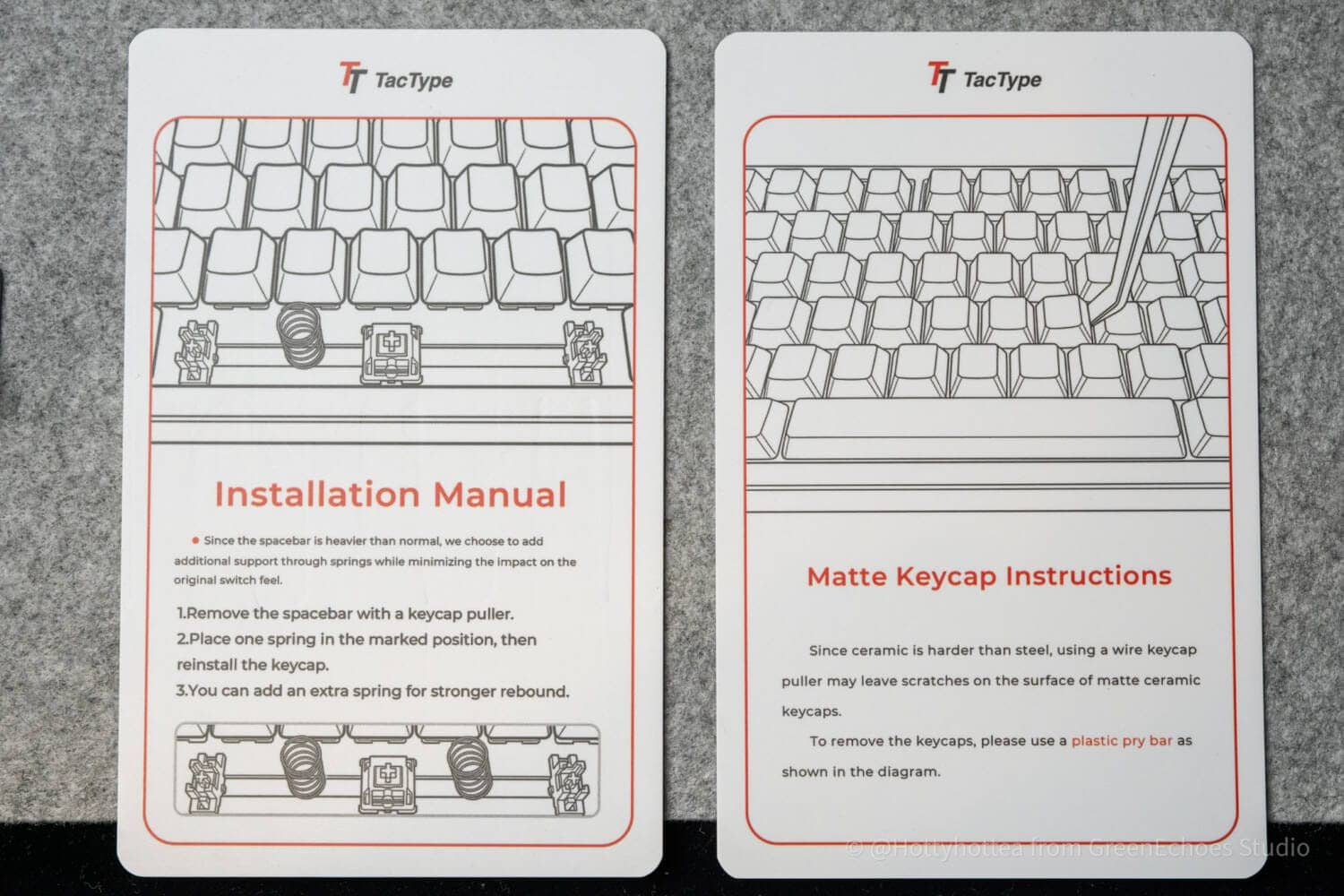
Each keycap is individually packed, so there’s no worry about them getting scratched during shipping.

These feature side legends rather than top legends.
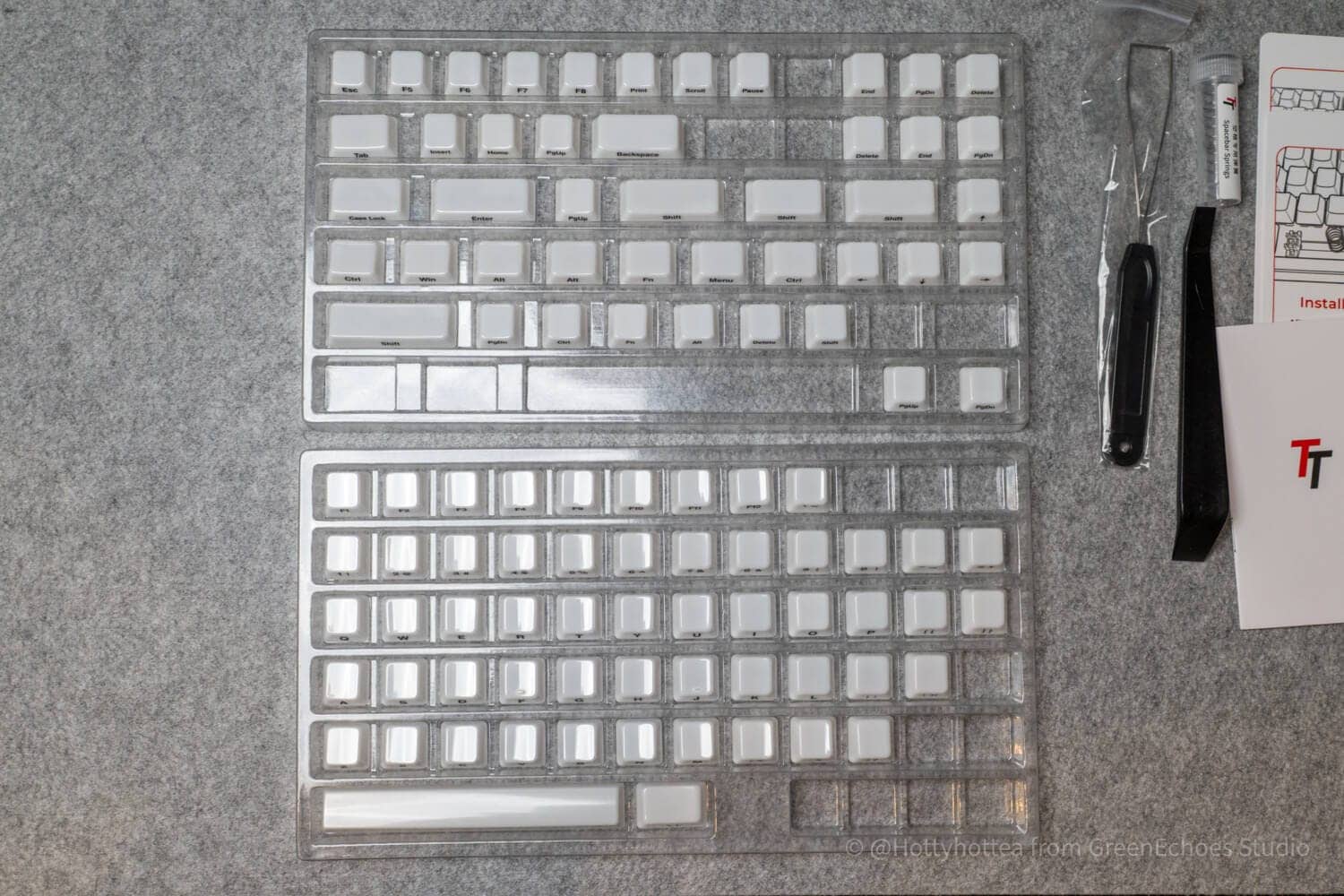
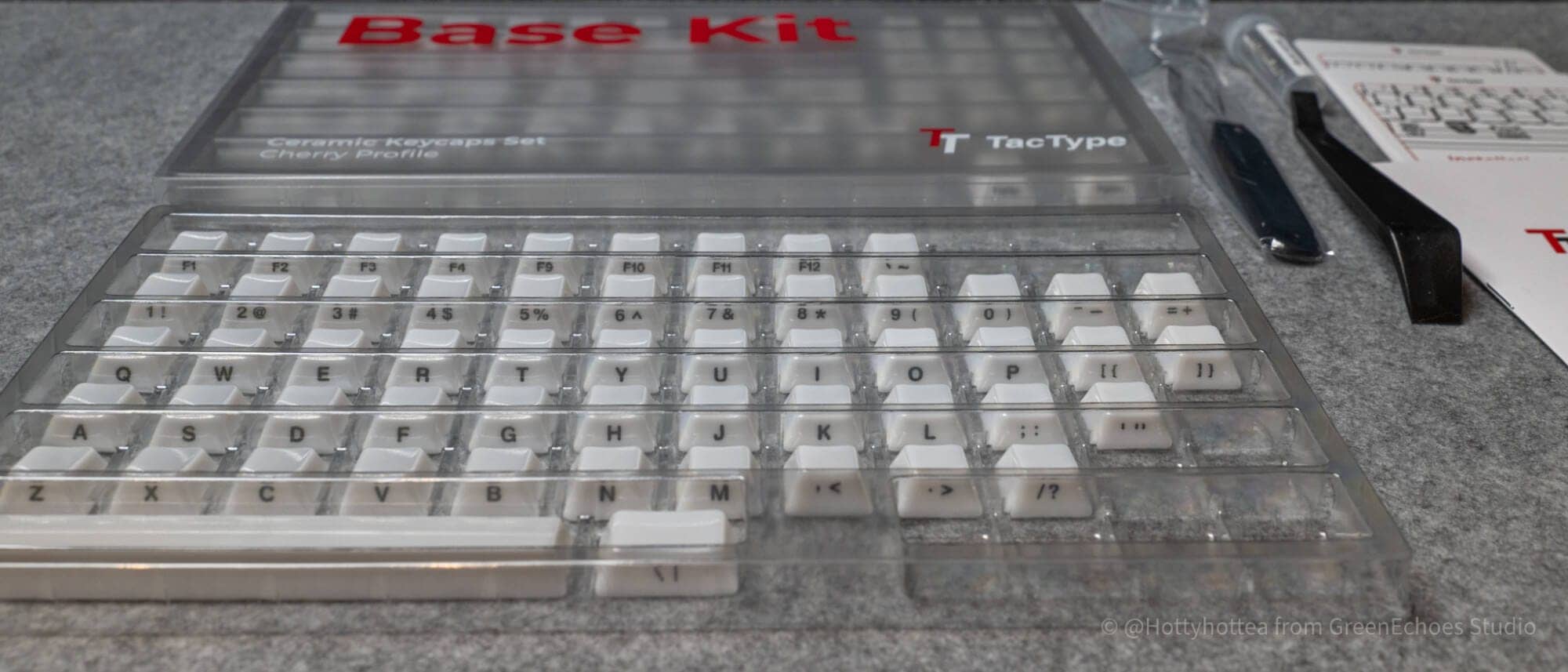

The font is a standard serif, with slightly thick, clear lines.

The surface of the keycaps is very uniform, giving off a pearl-like luster.

We also received RX1U Kit samples in White Matte, Black Matte, and Black Glossy.


The color is closer to cream than Cerakey’s white, and the uniformity of the keytops feels higher here.
 Kawamura
The exterior looks like premium chocolate—it’s wonderful.
They are beautiful enough to want to put on display.


Let’s look at the differences between each color.
From left: White Matte, White Glossy, Black Matte, Black Glossy.

Let’s look at the features of each.
White Glossy is a warm, cream-like color rather than pure white, and the uniform texture really enhances the glossy feel.

Light transparency is very high, and combined with the PC stems, it lets light through quite clearly.

White Matte has less reflection and an elegant, non-shiny texture.
The surface is very uniform here as well.

Light transparency is just as high as the White Glossy.

Black Glossy offers a mesmerizing level of shine.
With such a uniform surface, it almost looks like polished marble.


On the other hand, Black Matte looks more like charcoal or ink than a true black.
It has the beauty of an inkstone.
The black ceramic keycaps had lower light transparency.

The stems are made of PC material and are attached to the back of the ceramic keycap.
There are no issues with precision, but the PC material makes them feel smooth when swapping.


Now, let’s see how they look installed on a keyboard.


Pros and Cons of TacType Ceramic Keycaps

TacType Ceramic Keycaps are highly unique keycaps made from zirconia ceramic.
While you can enjoy a texture and weight different from standard ABS/PBT keycaps, there are also points to be aware of that are specific to ceramic.
Here, I’ll summarize the pros I felt during actual use and the precautions to check before buying.
Pros of TacType Ceramic Keycaps

- More affordable than other ceramic keycaps
- Unique material choice with zirconia ceramic
- High surface uniformity, especially the beautiful Glossy type
- Soft backlight diffusion thanks to PC stems
- Includes auxiliary springs for the spacebar
- Easy to partially install with split kits
More affordable than other ceramic keycaps
With the Full Kit at $74 and the TKL Kit at $59, the pricing is very attractive and more accessible compared to Cerakey.
The fact that they are even more affordable during the 3-day launch sale is not to be missed.
Using the Greenkeys reader coupon gives you an additional $5 off orders over $59.
Unique material choice with zirconia ceramic
While Cerakey uses alumina ceramic, TacType uses zirconia ceramic.
It’s interesting to be able to compare material differences even within the ceramic keycap category.
High surface uniformity
The Glossy type in particular has a pearl-like texture, offering the smoothness unique to ceramic.
The way they look changes with the light, giving them a compelling presence on your desk.
Beautiful light diffusion with PC stems
With the white keycaps, you can enjoy a soft glow created by the ceramic material and PC stems.
Unlike typical shine-through keycaps, the light bleeds through the material, which is a very distinctive look.
Includes spacebar springs
Because ceramic spacebars are heavy, light switches might have a slow return.
TacType includes auxiliary springs for the spacebar as a solution.
Easy to partially install with split kits
In addition to the Full Kit, they offer split kits like 60% Kit, Alphas, Modifier, and RX1U.
The ability to ceramicize just the alphas, just the modifiers, or just specific keys rather than replacing everything is a definite plus.
Cons and Precautions for TacType Ceramic Keycaps
- Be mindful of the spacebar’s weight
- Watch out for scratches on the Matte type
- Primarily for ANSI layout; difficult to use as-is for JIS (Japanese) layout
- Black keycaps have less backlight transparency than white ones
- White color tone differs from Cerakey
- Typing sound difference isn’t dramatic
Be mindful of the spacebar’s weight
The 6.25U spacebar is heavy at 25 g, which may cause slow return when paired with light switches.
It’s best to use the included springs or pair it with a switch that has a decent actuation force.
Watch out for scratches on the Matte type
The Matte finish is attractive for its understated look, but you need to be careful about scratches if the ceramic pieces rub against each other.
When carrying or storing them, try to prevent the keycaps from rubbing together forcefully.
Designed for ANSI layout
TacType Ceramic Keycaps are basically designed for ANSI layouts.
They aren’t suitable for replacing every key on a Japanese layout keyboard.
Black keycaps have weak backlight transparency
While white keycaps offer soft light diffusion, the black ones are much more opaque.
If RGB lighting is important to you, consider how the color choice will affect the look.
Color tone differs from Cerakey
TacType’s White is a bit warmer compared to Cerakey’s white.
If you’re expecting a pure, stark white, it’s a good idea to check the color in photos first.
Typing sound difference isn’t dramatic
Compared to Cerakey, TacType isn’t a completely different beast; both follow that deep, thocky ceramic direction.
While there are material differences, I didn’t feel this was a product that differentiates itself solely on sound.
Summary

TacType Ceramic Keycaps are a new alternative in the ceramic keycap market following Cerakey.
If Cerakey is the one that popularized the ceramic keycap genre with alumina, TacType is a product that offers a new choice through its zirconia ceramic material and more accessible pricing.
However, you do need to be careful with the weight inherent to ceramic keycaps.
The spacebar in particular can affect return when used with light switches, so you’ll want to consider using the included springs or pairing it with a heavier switch.
For those who want to enjoy the hard touch, deep typing sound, and the sheer presence of the material itself, TacType Ceramic Keycaps are a very interesting option.
- First published: May 7, 2026
- Last updated: May 7, 2026
- Method: Based on manufacturer’s official release
- Reference/Source: https://tactype.com/
- Conflict of Interest: Product provided: Yes | Affiliate links: Yes


Google検索の「優先ソース」にGreenkeysを追加します
Add Greenkeys as a Preferred Source on Google

