


On April 22, 2026, Diatec Corporation—known for FILCO-brand keyboards—announced on its official website that it has ended its business operations.
The company also reported that it had destroyed and deleted all personal information it had obtained and held for its online sales and user support operations by that same date.
The shutdown has already been reported by multiple Japanese media outlets, and news that this long-established maker—known for the FILCO brand and the Majestouch series—has suddenly ended operations has sent shockwaves through the keyboard community.
As of now, the reason for the closure has not been disclosed on the official website.


News that sent shockwaves through the keyboard industry
For Greenkeys, the point of covering this news isn’t just to report the fact of the shutdown.
The basic facts have already been covered by major media outlets.
FILCO was a brand you couldn’t ignore when talking about mechanical keyboards in Japan.
In particular, the Majestouch series was, in the author’s view, a benchmark for people choosing mechanical keyboards as practical tools—well before gaming keyboards and custom keyboards became as mainstream as they are today.
A solid layout, a sturdy case, the reassurance of a tool you can use for years—and a proper lineup of Japanese-layout options even among mechanical keyboards.
FILCO / Majestouch felt like a key reference point as a “standard” keyboard.
The lineup was extensive, ranging from compact models like the Majestouch MINILA-R Convertible to full-sized keyboards like the Majestouch Convertible 3.
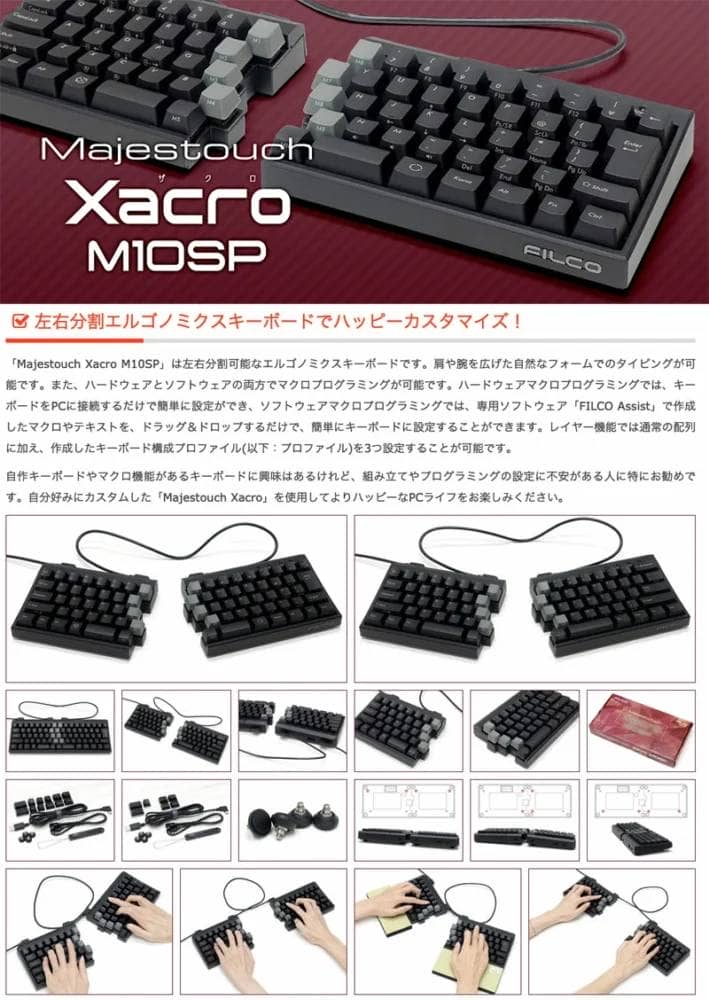
Recently, they’ve shown a lot of energy, even launching the new Majestouch Xacro M10SP split keyboard.
Founded in 1982: a long-established company behind the FILCO brand
Diatec was founded on June 17, 1982, in Ebisu, Shibuya-ku, Tokyo.
It initially started as a semiconductor sales trading company, then went on to develop LCD control controllers and more, building its path as a company dealing in PC peripherals.
According to the company profile, its head office is in Sotokanda, Chiyoda-ku, Tokyo, and its business is listed as “development, import, and sales of PC peripherals.”
What left a particularly strong impression on keyboard users was likely the Majestouch series under the FILCO brand.
Today, mechanical keyboards span many categories—gaming, custom, low-profile, magnetic switches, and more.
But when Majestouch first appeared, mechanical keyboards weren’t nearly as common a choice as they are now.
2004: The first Majestouch and CHERRY MX

When talking about the history of FILCO / Majestouch, it’s hard to leave out the first Majestouch, released in 2004.
In its 2022 press release announcing Majestouch 3, Diatec explained that in 2004—when membrane keyboards dominated the market—it launched the first Majestouch as FILCO’s flagship model, equipped with German CHERRY MX switches that no Japanese keyboard maker was using at the time.
That carried even more significance than it might seem from today’s perspective.
Today there are countless CHERRY MX-compatible switches, and mechanical keyboards are widely discussed as highly hobby-oriented input devices.
But back in 2004, in the Japanese market, it still wasn’t at all a given that everyday users would choose a keyboard equipped with CHERRY MX switches.
FILCO / Majestouch can be seen as the brand that brought that option into the Japanese market.
A brand that kept insisting on staying the same
Majestouch’s defining trait wasn’t just adopting CHERRY MX early.
Even in its 2022 release, Diatec explained that nearly 20 years after the first Majestouch launched, it had continued to stick exclusively with CHERRY MX switches.
It introduced Majestouch 3 as a model that carries over the case design of the original 2004 Majestouch while completely refreshing the PCB, microprocessor, and more, adding support for USB 2.0 and full N-key rollover.
In other words, Majestouch wasn’t a product that chased trends by drastically changing its look—it was a brand that kept a consistent form while maintaining a standard.
That balance between “not changing the standard” and “updating what needs updating” may have been what made FILCO feel like FILCO.
When it comes to Japanese-layout mechanical keyboards, it was FILCO
FILCO’s presence wasn’t limited to specialty shops or a subset of keyboard enthusiasts.
As far as I can remember, FILCO mechanical keyboards were often found in electronics stores, making mechanical keyboards feel like a much more accessible option for everyone.
Even here in Niigata, where I live, I remember seeing FILCO mechanical keyboards on display at Bic Camera.
In Japan—where mechanical keyboard culture still hasn’t fully taken hold—that felt like it carried a lot of weight.
Being able to encounter “mechanical keyboards” as an option at a big-box retailer, without relying on overseas online shops or specialty stores.
FILCO was one of the brands that served as that entry point.
In today’s keyboard market, options have expanded dramatically: overseas brands entering the space, gaming keyboards using Hall effect switches, low-profile and split keyboards, and more.
Within that, FILCO felt less like a brand at the center of the latest trends, and more like a presence that supported the long-standing “regular mechanical keyboard.”
CHERRY’s restructuring—and the end of an era
Another symbolic point is that CHERRY—the side Majestouch long stuck with—has also been going through major restructuring in recent years.
CHERRY MX long remained a benchmark for mechanical keyboards, but in today’s market the underlying technologies that make up input devices have diversified, with compatible switches, magnetic switches, low-profile switches, and more.

You can’t simply link Diatec’s shutdown to changes on CHERRY’s side.
Still, the fact that FILCO—so closely associated with an era of mechanical keyboards built around “CHERRY-made key switches”—has come to an end inevitably feels like a turning point.
What FILCO left behind
Even before keyboards were talked about as a hobby the way they are now, FILCO / Majestouch provided an option for choosing mechanical keyboards as everyday tools.
Looking back, I think their contribution to the industry was truly significant.
Diatec’s shutdown is sad news for keyboard users.
At the same time, I picked up my pen to properly record the footprint FILCO left in Japan’s mechanical keyboard market.
This news makes you think deeply about the future of Japan’s keyboard industry.
- First published: April 25, 2026
- Last updated: April 25, 2026
- Reporting method: Referenced the manufacturer’s official website and various press releases
- References/Citations:
- Diatec Corporation | Company History
- Diatec Corporation | Company Profile
- PR TIMES | FILCO Majestouch 3 Announcement Release
- ITmedia PC USER | Diatec, the company behind the FILCO brand, shuts down
- PC Watch | Diatec, maker of “FILCO” and “Majestouch,” shuts down
- Greenkeys | What’s happening with CHERRY’s restructuring?
- Conflicts of Interest: Product Offering: None Monetization Link in this paper: None


Google検索の「優先ソース」にGreenkeysを追加します
Add Greenkeys as a Preferred Source on Google

